
Snapdragons.

“When life doesn’t seem worth the living
And you don’t really care who you are
When you feel there is no one beside you
Look for a star.”
–Tony Hatch, “Look for a Star”

The Nutcracker by Tchaikovsky. A nice complete version with Sleeping Beauty highlights available on Philips 2 CDs. Enjoy joy to satisfy the heart and soul of any Inner Child.

(from the 1955 Johnson edition)
first line number and poem number
A narrow fellow in the grass–986
Because I could not stop for death–712
Before I got my eye put out–327
Dare you see a soul at the white heat?–365
“Hope” is the thing with feathers–254
I cannot live with you–640
I died for beauty, but was scarce–449
I dwell in possibility–657
I felt a funeral in my brain–280
I heard a fly buzz when I died–465
I like to see it lap up the miles–585
I taste a liquor never brewed–214
I’m ceded, I’ve stopped being theirs–508
Much madness is divinest sense–435
My life closed twice before its close–1732
My life had stood a loaded gun–754
Safe in their alabaster chambers–216
Tell all the truth but tell it slant–1129
The brain is wider than the sky–632
The props assist the house–1142
The soul selects her own society–303
There’s a certain slant of light–258
This world is not conclusion–501

The longer you live, the more you realize how subjective and agenda-ed “Truth” is. And how politicized everything is. I still remembering reading Josephine Tey’s excellently entertaining and suspenseful The Daughter of Time for an English 20 course (grade 11 academic) I was getting ready to teach. I was very impressed by all the history and emerging truths and epiphanies. It was just such a neat book blending fiction, mystery, and real history. And Tey made the reader feel like he was being let in on a secret and miscarriage of justice with regard to Richard’s personality and reputation. Long before I read 1984, in this book I encountered U.K. truth-effacers and vested interest/agenda-ed types hard at work exerting power and control over the public with a tissue of lies.
Getting at the truth about people and events in history is life-long work potentially, as John Ashdown-Hill, the author of The Mythology of Richard III has learned over the decades as he constantly tries to keep truth upfront about a controversial historical figure, the notorious king whose bad reputation was ensured by Shakespeare’s famous history play.
Ashdown-Hill’s research on RIII was instrumental in motivating the Looking for Richard project that led to the discovery of Richard’s gravesite, referenced as ‘The King in the Car Park’ (a phrase that was the title of an amazing U.K. documentary)..He does a nice job of keeping facts to the forefront and pointing out errors that the City of Leicester and U of Leicester have made since taking over Richard’s remains and all the glory of the recent dig and story. (Basically, the city and university have ‘written out’ the author and work of the Looking for Richard project–a similar kind of whitewash and rewriting of history that the Tudors did on Richard.)
To begin with, Ashdown-Hill argues convincingly for Richard not being ugly and misshapen, not being a serial killer, not being Anglican, and not being a usurper or tyrant. He dispells burial myths and reveals how he suggested places to dig to find the dead king’s body and actual gravesite. He reveals the big money in the tourist trade the city and university has unfairly usurped out of the selfless work of a great many other individuals and the Looking for Richard group. What is perhaps most bothersome to the author is how his findings have been ignored to the point of still misrepresenting Richard and many facts. Overall, this is a must-read book for anyone interested in English history, Richard III, historical research process, and how truth gets bent to serve the interests and greed of others.
Below is my own poem about Richard based on my knowledge of The Daughter of Time book and The King in the Car Park documentary. Perhaps what has bothered me most from the various agendas has been the actual man permanently lost in the process/es. He wasn’t perfect, but the amazing abuse and indignities he subsequently suffered were likely not deserved in the great scheme of things…
A Buried Life
O brave new world,
what fools these mortals be!
They found me under a car park
several feet down–Richard.
A gentle woman’s touch
released me from my private peace.
A slow, loving process
I had never known before.
Conniving and entitlements–
I once wanted it all.
Little did they who found me
know I wanted to be left alone
where I could not be hurt again,
to suffer further indignities.
And so they boxed and dated me,
then stood around my bones
in dark sterile rooms
wondering who I really was.
It was just a matter of more time
till technology and speculation
would have their way with me,
my puzzle-bones and their agendas.
They rejoiced to restore me
(or so they thought),
missing every inner bit that mattered
of feeling, dream, and passion.
A life, a man, being so much more
than identity and physical evidence
that I once was and still am, here.


(the two must-see Christamas movies of all time; recommended versions: 1951′s A Christmas Carol (VCI Entertainment)–intro by recently deceased Patrick MacNee of The Avengers TV series; 1947′s It’s a Wonderful Life (Alliance Atlantis)
…………………………………………………………
“He who loses his life shall find it.” -quoted by Joseph Campbell
Two of the most inspiring Christmas movies ever are the Alistair Sim version of Charles Dickens’ A Christmas Carol, and Frank Capra’s movie It’s a Wonderful Life. They have inspired many generations of viewers with their simple, yet profound core messages about life.
Both show us the great difference between (transitory, ephemeral, living) presence and (deathly, ghostly, forever) absence–or the extreme loss of presence. In the Dickens’ former, Scrooge comes to learn the hard way that absence can be a terrible point-of-no-return and that he has meanly absented himself from his family, his sister, her son, his fiance, his employee Bob Cratchit, and his business partner Marley. In his heartless obsession with accumulating meaningless wealth, he has also alienated himself from whatever good qualities he once possessed or valued in the past.
It is only through realizing unchangeable, irrevocable absences like those of his dead sister, fiance, and Marley and by being given a glimpse of a future without Tiny Tim and himself, that he is able to reconnect with finer values of kindness, love, and generosity. These values, in turn, help him to reconnect positively with both society and his once-better self. In the world of A Christmas Carol, the only other alternative is grim, stark hopelessness, suffering, and death, as amply revealed by the three ghosts who visit Scrooge.
Scrooge’s final appreciation of presence and being alive become epiphany and reason enough for him to celebrate and re/connect with the social world. Though this change comes late in his life, Scrooge magically finds that he can will any possibility into being with humor and a better attitude–key positive manifestations of both presence and consciousness.
Likewise, George Bailey, the main character in It’s a Wonderful Life, suddenly finds himself ‘lost’ and ‘gone missing’ in a way reminiscent of Scrooge, but, in contrast, he is truly a desperate man driven by crisis to the brink of suicide. The beginning of his salvation occurs at the bridge when he saves his drowning guardian angel Clarence. That event alone reveals George’s essential nature of putting others before himself, something he had previously done all his life.
Like Scrooge, he is shown life without his presence and an alternate nightmarish version of his own community–a negative view caused by his absence and his granted wish to never been born. After a final repentance, George is given back his less-than-perfect life, grateful for the chance to recover both presence and life. Like Scrooge, his limited/limiting, blinkered attitude changes and he embraces life, with all its problems and shortcomings. That said, both protagonists find a richness through their experience and a renewed appreciation of presence and others. And as both characters discover, nearly anything becomes possible when one fully accepts and embraces life and presence.
Today we still hear that Christmas can be a stressful, isolating time of year for some individuals in our society. For those who may find themselves similarly ‘lost’ or ‘gone missing’ like George and Scrooge, these two classics offer helpful perspectives on some of the ‘basics’ for finding one’s better/best self, or recovering meaning within one’s own life.
Del’s last Christmas was in 1997. He had been diagnosed with cancer in September that year and the cancer and treatments had started to obviously ‘waste’ him, something I became aware of when I was in Winnipeg that November. I drove the family the last week in December in -35 C across the prairies for them to be with him, for likely the last time as we all likely knew. He was very tired all the time and could not eat more than 2-3 mouthfuls, but he was in good spirits for the visit. In particular, he showed the kids my parents’ photo albums and various artifacts around the one-bedroom apartment. It seems like he could only do a couple of hours with us each day, he was that exhausted. However, we spent New Year’s Eve with them before we drove back home the following day.
Rose’s last Christmas was, nine years later, in 2006. (This time, we flew to be with her.) She was able to walk, slowly, three flights of stairs at that point so we were able to take her out for a drive in the rented van to see the city lights–something she really appreciated, even commenting that her pain had magically subsided. We also took her to Assiniboine Park to the zoo part where my dad’s bench and plaque were and cleaned the snow off for pictures. Special treats included a Chinese food supper one night and Rose dancing with her teenage grandson. Unlike Del, I don’t know that she felt this was the last time she would see the family, and we know that she had hoped to make it to my son’s wedding in the summer of 2007 (which sadly was not to be).
Amazingly, Del and Rose died on the same day/date March 31. He passed quickly in Winnipeg General after learning one morning that he would be going to a long-term care facility, not back home. She died quickly, within days, in the Riverview cancer facility after she was removed from home via ambulance. The decline was fast following her admission, after she realized and anxiously whispered to me “We forgot the cigarettes.”
They died within one hour of each other on that same day. There is a lot that is mystery and I don’t believe my mother was aware of dates or time for the last week before she drifted into the coma that led to her admission. But the irony and significance of their death dates and times did not escape me. My parents were that close.
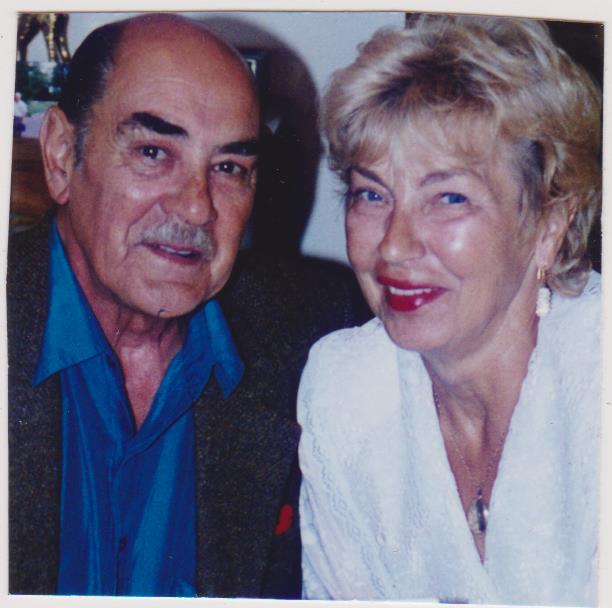
Del and Rose were generally very happy people and inseparable in their retirement years. They were always quite active, walking miles to and from the park they loved each day. They did a lot of line and round dancing, and were snazzy dressers–formal and classy-looking. As you can see from the picture above they were vibrant, outgoing types. They enjoyed travel and considered themselves very fortunate for even the smallest of gifts. And they always looked out for those older and less fortunate than themselves, often befriending and visiting these people, even non-family members.
Gifts, company, family, kids, peace and joy aside, Christmas is also a time for reflection and perspective. Life and Christmas, in many ways, is simply presence and absence. And sometimes we get lucky–though one should never delay, especially when one has the intuition and opportunity (which, of course, was not there again for both these people the following Christmases). Del and Rose truly enjoyed those last Christmases as did I and the family. Those were special, unforgettable Christmases for all concerned, even for those–my remarkable parents–no longer present today. How they smiled and laughed those final visits. How grateful all were to be together, despite the schedules and geographical distance, even in those difficult, challenging, and obviously so sadder times.
March 31 is always a memorable day. But Christmas–those last Christmases is how and when I fondly remember Rose and Del. When they were last with the family they loved, at home, in their world.


