John Steinbeck’s “The Red Pony” (1949)

Screenplay by Steinbeck, based on his children’s book/novella; directed by Lewis Milestone (who also directed the original classic Of Mice and Men).

This was intended to be family film about a boy’s coming-of-age via horse. The only character of interest is Billy Buck played by a restrained Robert Mitchum. It certainly made more sense when and where it was written: the 1940s Salinas Valley. Steinbeck, no doubt, either experienced something like the plot or knew of experiences like it.

There is one odd gruesome scene in which a combination of live and stuffed vultures are ‘thrown at’ the boy as he tries to rescue his animal pal. For that reason, the film should not be viewed by kids younger than, say 6 or 7. In any case, the film will be more of interest as a curiosity piece for rural kids still in touch with farm or ranch animals. And only the staunchest of Steinbeck fans will want to check out this one which reads better as a book, ultimately, A mention of the cleaned-up DVD print which uses the olde limited Republic Pictures styled-color: the print is generally clear but still on the dark side and fuzzy overall, which definitely affects how the movie affects modern viewers.

Posted in Uncategorized | Leave a comment

Yet Another Film Classic: Becket (1964)

002 (30)

(available from MPI Home Video)

Those were the days, indeed. One of the best historical films ever made and a strong script that began as a stageplay, Becket is a study of two friends, betrayal, and conflict between state and church. Henry II (Peter O’Toole) loves his friend Becket (Richard Burton) whom he–unilaterally circumscribing Rome and the Pope–installs as England’s Archbishop of Canterbury. Becket, who has long given in to Henry’s wishes, changes after the appointment, taking the latter seriously, and becoming God’s agent in earnest; hence, the main conflict.

Both great actors are in fine form. O’Toole is very believable as the rejected King who would have laughingly given away the world for his friend. As he puts it, Becket does not love him as much as he does Becket; hence, another deep conflict and sense of betrayal. Burton is equally convincing as the man who finds a higher loyalty, calling, and purpose. The film has a strong screenplay (based on Jean Anouilh’s play) by Edward Anhalt, terrific music by Laurence Rosenthal, and minimal cuts by editor Anne V. Coates and director Peter Glenville who wisely let the scenes between the lead actors flow uninterruptedly, unlike the choppy, not-necessarily-purposeful-editing which invaded mainstream films after the sixties.

Becket is a genuine, memorable film classic which still stands up today, especially for filmgoers interested in great scripts and masterful acting performances. Highly recommended for people largely bored by and dissatisfied with most mainstream films made after 1990.

Posted in Uncategorized | Leave a comment

Webworks

All it takes are two spinners
to collect the unsuspecting flotsam
of long summer nights.
Apart in the same yard
we cast our respective filaments–
some to control, some to set free,
some in love, some from death itself.

Silver on dark,
I braid a net to enhance my loves
you–a snare for your gossamer schemes.
I follow impulse with fiber-like freedom,
the warp of odd honesty.
You spin charm like crazy
and admire a dead collection.

Snared in your own beguiles,
you measure success
by the material bodies around you.
I, by the spirits who sing
spinning songs
beyond our entrapments.

You connive and hatch.
I invent or enhance.
My designs, your makeshift.
My resolution, your madness.
My labyrinth, your skeletons.

Keep your intrigues to yourself,
the nightly feedings that have
kept you alive and dead for so long.
Though we may die this winter,
we have chosen then
and I shan’t be catching you later.

Alone now, I spin quite free
far from your threadbare joy.
I have been victim enough
to know the Sisyphus pangs
of starting each arc over.

Honest now, I cannot spin for you
and you are too busy with
your morning morgue
to taste of mercy or honour.

Centered, I will be fine in the autumn sun.
Improved, I will continue my passion
to teach and let go.
True, I shall weave like this, alone forever.

(previously published here Nov. 6, 2012)

Posted in Uncategorized | Leave a comment

After all these years, I still observe and say

that it is morally wrong to possess another. Using others to satisfy one’s own ego is as old as Magwitch or Miss Havisham ruining Pip in Great Expectations. People are not meant to be manipulated or controlled as means to a personal end. They are ends unto themselves and, as such, deserve respect and freedom as autonomous individuals.

Posted in Uncategorized | Leave a comment

People Who Use Twitter

are often shallow, empty-headed, superficial, flighty, silly, slight, unintelligent, foolish, banal, fatuous, jejune, vapid, trivial, obvious, dull, literal, witless, foolish, ridiculous, scatter-brained, capricious, trite, vain, dumb, childish, immature, ignorant, and not to be taken seriously at all. If you want a true, thoughtful, smart, sensible, unselfish, unconventional, focused, serious or deep friend or relationship, avoid persons who are addicted to Twitter, who delude themselves into believing that they really matter to many others or are changing the world with several-word outbursts or shouts.

Posted in Uncategorized | Leave a comment

To Cover or Not to Cover

IMG_1632IMG_1564  DSCN6703DSCN6700

When you spend a fair bit on and spend a fair chunk of time buying, planting, and caring for flowers, you hate to see them ‘go’ early in September. And always, there is a choice. To preserve some natural beauty (and this can last till Halloween, making fall around the yard brighter as it cools off) requires covering with sheets. One can’t always trust the more fallible Environment Canada these daze either–they might predict +1, but you’re taking a chance if you don’t cover when it’s that close to freezing. Many’s the time I’ve seen that kind of prediction turn into a killing frost of -4, -5.

Covering is a choice necessitating moving more sensitive plants or those you want to preserve off the ground usually and onto a patio or into a garage. The first cover involves putting in stakes, usually thin round ones, to hold up the sheets above the flowers. The subsequent covers take about 10 mins. max. each–not too long to ensure the survival of your preferred natural beauty. Sheets can be left outside, especially if dry, though you have to watch for winter-nest-building squirrels who may come by to tear/bite off strips. Sheets can alternately be stored inside the house each night if not wet.

Sometimes you may cover up 3 or 4 days in a row. But sometimes one has to accept the inevitable like when it dips to -4, -5 one or more nights in a row–facing facts, letting Nature take its course. I have enjoyed having planters with flowers, especially yellow chrysanthemums in front of the house; it gives one a truly good feeling to come home when you have bright beauty to welcome you. Similarly, it is great to gaze out of a backyard window onto a yard and patio with colorful flowers that you’ve invested much time and effort in, watering each day all summer into October and sometimes–as I mentioned above–up to Halloween.

There are many lazy people and a lot of people who would not care this much about flowers, beauty, color, or the appearance of their yards. As I said, it’s a choice and one of preferred images and preferred atmosphere. We all live in contexts and we all decide what is worth whatever sacrifice. Covering has been a key one for me every year, every fall. I choose (Natural) Beauty over the ravages of Time and Death. I choose to cover for more continuing pleasure another day. It is thus I walk the talk–Beauty being one of the top 4 priorities in my life.

(reprise entry 1st published here Sept. 11, 2014)

Posted in Uncategorized | Leave a comment

The Annual Fall Pilgrimage to the Mac

IMG_1647

(the patio terrace after 7:00–on a really warm evening, one can dine out here with added heat lamps)

IMG_1648

(the best time to see the gardens is about the 2nd or 3rd week into Sept. before the fleurs are taken out)

IMG_1649

(the garden globe lights complement the garden walks)

IMG_1650

(the beds and pots are particularly impressive)

IMG_1653

(the old hotel–now 100 years-old–shows itself off best as the sun goes down)

IMG_1654

(beauty and splendor everywhere the eye turns)


(old friends for 40 years, me on left, with Ken, right–back after a January wonder-tour-month in Aus)

IMG_1664

(the entire scene becomes more magical as the sun goes down)

IMG_1667

(a fitting finale to another special evening of an annual ritual)

Every September on a warm fall weekday evening, we wend our way to the Jewel of Edmonton–the Macdonald Hotel to join my oldest Edmonton McNally teacher-friend and his wife for sup at the Confederation Lounge and a stroll about the hotel garden overlooking the river valley. It simply does not get better than this for conversation, memories, the best Tortellini in town, and the brimming beauty of the flowers and river valley in the pleasant evening air. This year’s trip was made special by meeting and chatting with Giselle Denis, one of our burgh’s interesting new landscape artists, in the lounge as she painted two striking canvases from scratch. She and I shared our views of art, process, synesthesia, and how word, music, and movement, music, and art influence one another when she took a break.

Posted in Uncategorized | Leave a comment

Orson Welles’ “Macbeth” (1948)

004 (12)

The version of Macbeth that nearly everyone remembers is Polanski’s with the ‘gross’ severed-head ending. It certainly is the sensuous and ‘glandular’ Macbeth which revitalized this classic for a lot of readers and filmgoers. Earlier in this blog, I reviewed Kenneth Branagh’s very interesting version staged and filmed live in a church. It is easily the best live play version of this play ever committed to film. But what of Orson Welles’ 1948 version, long-forgotten and mouldering, waiting for a decent restoration? Now thanks to Olive Films, we can see and hear Welles’ take clearly, without technological distractions and flaws.

Welles not only starred in this version but directed as well. The first thing to be said in the film’s favor is that all the actors speak with Scottish accents. To critics and North American viewers of Welles’ day, this was off-putting and doomed the film for the wider general public. Personally, I found the language easy-to-understand and follow. If anything, Welles makes one savour and feel the words; for instance, Macbeth says in “blood steeped o’er” instead of “stepped o’er” as in often done in productions.

His own performance is suitably haunted-looking; he is uneasy and anxious from start to finish, conveyed mostly by his voice, face, and eyes. Jeanette Nolan as Lady Macbeth is given lots of room to bring out the range of her character, mostly noticeably in the sleepwalking scene. The other supporting actors are reasonable, and the non-Macbeth scenes of the doctor with the maid and the Macduff ‘conversion’ to revenge turning point are allowed to play out in reasonable fullness.

Although Welles shot in the Republic studio with minimal scenery, he manages to give a primitive, yet haunted ‘otherworldly’ look to the sets and settings. The black-and-white photography also helps to create more focus on the speeches, actors, scenes, and stories. Welles does move some lines and speeches around and in some cases moves actors into different scenes; for instance, Macbeth is first on the scene for the Macduff slaughter. The witches are seen effectively at the beginning and their words are echoed elsewhere including the weak ending which just has them simply commenting that the charm is wound up.

As previously mentioned, there is a primitive visual look to the entire production. Welles wears headgear suggesting Taras Bulba or Genghis Khan, but given the Macbeth plot was taken from early Scottish history, I suspect that Welles (who was very conscious and meticulous about the effects of detail) probably derived this choice from actual early Scottish illustrations.

This DVD version from Olive Films deserves another big thanks for restoring the long-lost 18 mins. and restoring the film to its full 107 minutes. Welles’ faithfulness to the original play detail (notably via the accents and costumes) in this production amazingly shot in less than a month (!) is typical of the high standards and results he always generated despite low budgets and typically numerous other obstacles. The DVD is also recommended for students or first-time seers who want to view a production closer to the one that was likely produced originally at the Globe Theatre in Shakespeare’s time as well as for those who want to check out the interesting seamless changes Welles made to the script that help to create a very unique take on this deservedly famous tragedy.

Posted in Uncategorized | Leave a comment

Ken Russell’s “The Devils” (1971)

001 (71)

(Two huge labours of love: Ken Russell’s film The Devils, still photo of the great Vanessa Redgrave as the mad nun Sister Jeanne)

002 (30)

(and Aldous Huxley’s book (which inspired the film), Harper, 1953, dust jacket)

003 (17)

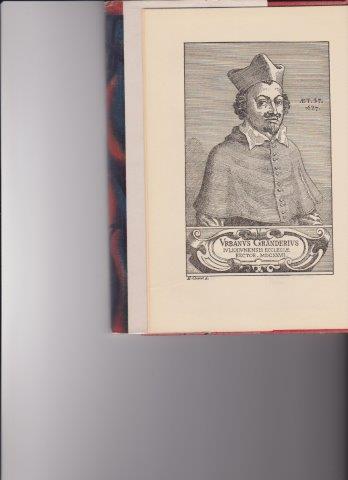
(engraving of actual Father Grandier, 1637)

……………………………………….

Anyone who sees this timeless masterpiece of sexual, political, and religious corruption needs to know it was based on actual events involving suddenly crazed Ursuline nuns in the early 1600s French town of Loudon. The movie is solidly based on Aldous Huxley’s The Devils of Loudon, an historical narrative with reflections about the episode. The facts in the film are very much the facts of the actual events with Ken Russell’s imaginative embellishments suggesting ‘how crazy things got’ and how each of the various participants acted.

The film has been arguably the most famous controversial film of all-time with U.K. censors snipping the infamous never-seen rape of Christ scene and Sister Jeanne’s indecent act at the end of the film before the film was released. What’s left of Russell’s original vision is available from BFI on DVD in a PAL version, viewable on most modern computers on this side of the ocean. It comes with the warnings of 18–contains strong violence and sexualized nudity, though the other/wise bombardment of the viewer’s senses, feelings, and mind is likewise over-the-top, to put it mildly, reflecting the mania and craziness of this actual historical episode. It is “an assault on the senses”, visually and audially, mostly because of the story details, wild acting performances, manic pacing, abrupt juxtapositions, intense conflicts, Derek Jarman’s bizarre designs, David Watkins’ amazing cinematography, and Peter Maxwell Davies’ other-worldly ‘score’. You will never see anything remotely like this on screen ever again. The Devils is totally unique and timeless.

In real life, Father Urbain Grandier was the Loudon vicar who became the main scapegoat and lightning rod for much of the frenzy. He was falsely accused of causing devils to assail the nuns which played into the political agenda of Cardinal Richilieu who sought the destruction of the town. Grandier was burned at the stake as a sorcerer no thanks to the ravings of the prioress Sister Jeanne and the witch-hunter Father Barre. The part of the seriously contrite, town-defender Grandier gave Oliver Reed his best-ever performance. Vanessa Redgrave is superb as the hysterical, untrustworthy Jeanne, who ‘flips’ into madness when the moment calls for it. The supporting actors also gave their performances of a lifetime, including Dudley Sutton as the sadistic opportunist Baron and Murray Melvin as the memorable priest who has misgivings about the whole tragic debacle. For those who go on to read Huxley’s terrific book, there is more to the story than what Russell covers.

All in all, The Devils and The Devils of Loudon together make up a fascinating study of human beings ‘losing it’, easily if not more engrossing than Arthur Miller’s The Crucible and the events of the Salem witches hysteria. Huxley tells more than could possibly be covered by the sensational film, especially what happened later after Grandier’s death. Highly recommended for anyone interested in studies of madness and how groups of people with agendas can persecute and scapegoat innocent others. Also for anyone interested in the exploring the abuses of religion and how evil can gain the upper hand on good. One of the most memorable books you will ever read and a memorable horrific film experience presented the weirdest mish-mash of beauty and truth ever shown in theatres. Mark Kermode and BFI deserve great credit for bringing this unduly-neglected masterpiece back to the attention of filmgoers everywhere. (Kudos for Kermode’s/Russell’s fascinating DVD extras and trivia, too)

Posted in Uncategorized | Leave a comment

The Art of the Impossible: Walt Disney

(notes after the first hour of the PBS Walt Disney documentary)

It, like life, reveals how much is process, how one gets from A to B to C, etc. The familiar story of an American hero or any successful person who starts with lowly or ordinary beginnings and goes forth ‘to make a name for himself’. A story of imagination, dream, and obsession culminating, in this case, with Disney’s first surprise mega-hit full-length feature in the Dirty Thirties–Snow White and the Seven Dwarfs. Imagination and dream and belief in those two–the art of the impossible, overcoming limits: (fantasy/imagined) death and the limits–then as now–of cartooning and animation: that that which is pretend, ‘unreal’, fantastic can transcend whatever limits if the audience believes in the illusion.

That feature film required great financial risk and slave-like workers, the latter who ‘caught’ the vision and obsession of the creator Walt Disney (who acted out the storyline first by himself live onstage!). An amazing story of process and how dream can transcend whatever naysayers, nervous Nellies, towering obstacles, and impossible odds.

(after watching rest of documentary)

Disney’s success of Snow White was later balanced by the financial disasters of Pinocchio and Fantasia, and a lengthy strike by his under-appreciated studio staff. he bore grudges after that, even suggesting a former valued worker and his new studio were ‘Commies’. It took him a while to have the hits of Davy Crockett, the Disneyland tv show and the massively popular Disneyland park. The workaholic Disney was in the process of getting Epcot up and running when he died suddenly, a year after his cancer diagnosis. Overall, Disney had tremendous imagination, guts, determination, vision, and high expectations. Unquestionably, he is one of the great Americans who influenced the world through his prodigious gifts of entertainment for children and families.

……………..

On a passing personal bio note, I regarded Disney and his presence in our Sunday living room as an eagerly-anticipated weekly delight in black-and-white. Kids looked forward to each show, wondering which of the kingdoms it would come from: Adventureland, Fantasyland, Tomorrowland, or Frontierland. At the time, I was into Classics Illustrated comics, and enjoyed the Frontierland broadcasts. But over time, it was the Fantasyland segments that were eagerly looked forward to, particularly Chip and Dale, and Goofy.

Disney himself was the kindly, unpatronizing surrogate uncle that most of us kids never had. For me, he was the main ideal father figure model through my elementary school years. His name was synonymous with great entertainment and my last favorite movie of his was The Jungle Book. Lady and the Tramp and Davy Crockett were long-time personal favorites, and the one that still creeps me out is Darby O’Gill and the Little People. Like millions of other kids of the time, Bambi and Old Yeller broke my heart and made me weep. And I still have a deep appreciation for the very moving death-bed-revival scene/happy ending of Snow White. Feeling is more important than death of whatever limits, as Disney showed. And incredible things were possible if one believed hard enough.
Posted in Uncategorized | Leave a comment