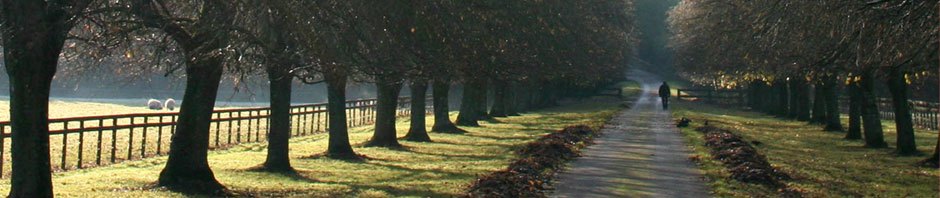

(Canada Day fireworks)
I stand here dazzled with my heart in flames at this
World of wonders
World of wonders
World of wonders
World of wonders
–Bruce Cockburn, “World of Wonders”
(Canada Day fireworks)
I stand here dazzled with my heart in flames at this
World of wonders
World of wonders
World of wonders
World of wonders
–Bruce Cockburn, “World of Wonders”
We all avoid it like the plague, but see it daily in the media or happening to others around us including family. As outsiders, it is difficult to fully feel the actual pain of others regardless of how much empathy or sympathy we may feel. We simply don’t like to feel that suffering can be as bad as it looks. Sometimes we even pray for others, for the relief of their pain.
And then it happens to us. Usually after we’ve ‘done it to ourselves’, been careless, or are blindsided. Raw, unmitigated pain after a dental extraction, throbbing migraines, or physical injury we had the option to avoid, but dumbly courted anyway. And we are caught in it; it becomes our sole focus. How can the bloody thing be gotten rid of? Nothing else. We can’t think about anyone or anything else. We totally lose the ability to distract ourselves or change the channel. And we become horribly isolated from everyone and everything else. Just on our own, suffering, pure and simple.
So much of our lives is an effort to stay in touch with others, to stay connected, to be part of ‘the group’, and yet there are things and situations that isolate us and totally alienate us from others, none no moreso nor worse than via excruciating pain. In the process, we become nothing more than the pain sensation per se. Like Winston Smith in Room 101 in George Orwell’s 1984. Wishing and begging for anything, anything to make the inexplicable, unexpected, relentless worst diminish or go away for even a few seconds of time.
………………………………………………..
Oct 4/addendum:
And so with ongoing, continuous pain, all one thinks about is when the next pain pill is due and if one can get any sleep, or find a sweet spot when lying down. In fact, sitting up may become preferable to standing, walking, or lying down–the only position that provides minimal relief. By necessity, walking is reduced to several yards at a time and one may stand only a several seconds at a time, bearing weight on an injured leg, for example.
The brief, poor periods of sleep weigh one down and start to make one ‘ragged’. Recall the Macbeths who could “sleep no more” and gradually became mentally unhinged. Scientists in our time have shown that people who can’t sleep begin to hallucinate much as did the Macbeths.
Relaxants become almost irrelevant when they don’t work or do the jobs they’re supposed to. And so one may be down to relying principally on whatever painkillers.
I recall two decades ago when I had a tooth that had to come out. Aspirin and its variants did not work. I was down to using cloves until I tried, for the first time, the anti-inflammant Ibuprofen which immediately reduced the relentless pain. About four years ago, after I had lost another tooth, I had been prescribed Tylenol 3, but again it was Ibuprofen which worked best. From these two experiences, I would have to say that mouth or dental pain is the worst; it is just too close to the brain and consciousness to be easily tolerated or diminished.
Well, one never knows. There is also the pain from cancer or kidney stones which necessitates the use of heavy duty painkillers such as opiods and opium. But when pain has become your life or you have been reduced to nothing but unbearable, intense pain, whatever solution is like manna or a godsend.
No question that serious pain slows one to a limited, limiting crawl; work or whatever social engagements are quickly abandoned so that the seriously injured or ill person can just focus on one thing–surviving pain from moment to moment. Time-wise, one’s clock is greatly shrunk, and night becomes day, and vice-versa. All the usual structures and patterns are toppled while one tries to get better, not knowing, of course, how long the pain will last or how bad it might get before things turn the corner and pain begins to lessen and one can have one’s usual life and routines back again.
Oct. 13/ Addendum
Finally the specific raw pain stopped and I was able to sleep, walk, stand, and do non-pain-control-focused things. In retrospect, this injury was a reminder about moderation, personal limits, and limitations. Interesting to be so non-stop incapacitated this long. I have no great fears of personal death for many reasons, but my God, this was much worse in my opinion. Raw continuous pain which responded to no medication and left me greatly sleep-deprived and relatively immobile.
I’ve previously said I would not wish cancer on my worst enemy. Now I will have to add the debilitating condition of long, deep pain and suffering to that statement. No, death is relatively small potatoes compared to cancer and significant pain beyond the reach of technology.
Instances of permanence these days in the Big E:
Major roads will be torn up everywhere for months at a time. There will be long traffic snarls in rush-hour including the freeways. One accident will basically shut down an entire road. When motorists turn to alternate roads, they find that these will be closed down too, so there are no fast ways to get around Katzville. The best times to get around the city remain Sunday mornings, after 10 pm evenings, or weekday mornings from 9:30-10. (Despite the road replacements, there remain millions of potholes and bumps everywhere that are still felt in new cars.)
The newfangled street lighting the city is putting in is actually street dimming, which does not light up sidewalks, driveways, yards or empty non-street light areas which once received residual light from the original street lamps. This new permanence make it safer for criminal activity and less safe for homeowners and pedestrians.
The signs on Edmonton streets mean nothing since they’re put up weeks before any activity or are left up for weeks after construction.
If there is a merge and you are the merger, you will taking your life in your hands if you try to merge.
Idiots will continue to speed through 30 or 40 km areas because they’re illiterate or don’t feel the signs are for them personally. Children continue to be at risk in their own neighborhoods.
The city will continue to cater to the less than 1% regular, all-year cyclists by removing parking and roads to create bike lanes even when no one uses them. (There are bike lanes in Mill Woods, for instance, on which I’ve never seen anyone in several years of bike lanes here cycling, including summer.)
The LRT will continue to be plagued with problems and decent, needful citizens will continue to stop using it. The escalators will never be fixed and the crime rate on or near the LRT will continue to grow.
Despite all the new building downtown, the evenings and nights there will continue to attract and be home to transients, criminals, and bums. The public library and Churchill Square will continue to be magnets for riff-raff.
Druggies will continue to find places like Old Scona and Boyle Street to shoot up. There are playgrounds, parks, and rinks in the city with needles on the ground. Walking or playing in the grass in the dark should be avoided.
Don Iveson and his clown council will continue to make dumb decisions and screw up repeatedly. The Uber, bridge construction, and LRT flaps are reason enough already not to vote for any of these losers again. They are lousy business managers and financial planners. They lack true empathy and fair judgement.

(Brian Miles and Paul Rischer harassing chick Diane Minaker while, uninterested, Rick and Wayne Fraser casually talk music and enjoy a laugh at the back of our grade 12 class before afternoon classes begin; photo by the talented Bill Barkman)
We were all young once.
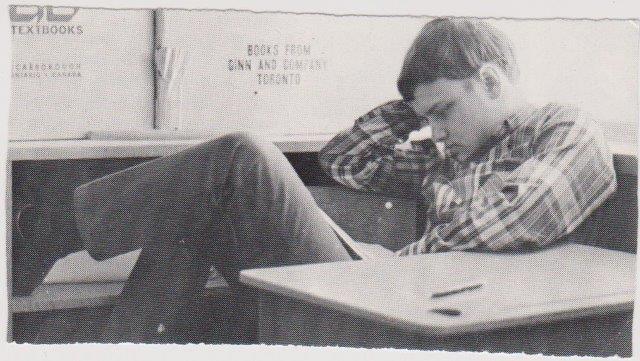
(Rick in gr. 12 English, back of class, reading poetry)
Much have I travelled in the realms of gold,
And many goodly states and kingdoms seen;
Round many western islands have I been
Which bards in fealty to Apollo hold.
Oft of one wide expanse had I been told
That deep-browed Homer ruled as his demesne:
Yet did I never breathe its pure serene
Till I heard Chapman speak out loud and bold.
Then felt I like some watcher of the skies
When a new planet swims into his ken;
Or like stout Cortez when with eagle eyes
He stared at the Pacific–and all his men
Looked at each other with a wild surmise–
Silent, upon a peak in Darien.
–John Keats, “On First Looking into Chapman’s Homer”
……………………..
The spring of 1967, English 300–grade 12, Silver Heights Collegiate, Winnipeg. Mr. George Brown’s class. The context–he invited each of us to pick a poem from our poetry anthology and to read it and talk about it, possibly analyzing it.
I had cased the entire book and picked this one. Simply put, it spoke to me in volumes–to my close connection with nature, my exponentially increasing interest in and love of words from grade 12 on, my essential core interest in possibilities and beautiful discoveries, and my only-child-based solitude. It was a very freeing, liberating poem, consciousness-wise. Very much an objective correlative of where I was at then and where I wanted to go, what I wanted to be, what I would eventually become. A romantic, a lover, a writer, a poet, a teacher, a performer, a possibilitarian, a seeker, and discoverer.
I memorized those words for the oral recitation; they emblazoned my mind, heart, and soul. I spoke with passion about the meaning and purpose of the poem. It was a true defining moment of being, performance, and turning point in my life. I had been marked for a life of literature–both reading and writing thereof. I would go on to teach 3-5 thousand senior high kids about literature in a 30 year career. I would go on to talk to thousands of English teachers across Canada, again, in a 30 year span from 1980-2010. As a singer-guitarist-songwriter, I would perform for several thousand more people (kids and adults) from 1969-2003. I would go on to write over 60 widely-authorized texts and guides for Canadian senior high students and teachers, books that would eventually sell over a million copies. I would go on to write hundreds of poems as well as songs, stories, and plays and read them in many venues and have well over 100 published, winning contests along the way. I would return to my gr. 12 teacher in the 1980s and tell him personally what this opportunity had meant to me. I would finally remember this moment and tell about it here today.
(edited and previously published here in Aug. 18, 2013)
We live in an age of image-laden screens and customized e-media, an age in which information, e-connectedness, and money rule all. Whatever remnants of poetry, as it used to be studied in schools and universities, has morphed into the blase song lyrics of the day. To most music listeners, their songs–regardless of who they listen to–are the poetry of their lives, and all the experience of language they are ever likely to need aside from some social talk.
What used to be called poetry in North America and England, for instance–such as the poems of Frost, Shakespeare, and Dickinson–can no longer compete with the demands and expectations of a fast-moving, impatient, easily-bored and distracted movie-headed populace. The genre formerly known as poetry is simply too boring, wordy, irrelevant, highbrow, and difficult to read. It requires context, an ability to read thoughtfully between the lines, and an interest in and love of words and language.
That poetry is not utilitarian has been known for many years. No remaining poets of the day can make a living as Frost and Service once did. A knowledge of–let alone an exposure to–poetry will not make one rich and connected as in e-connected. In short, there’s no money in it, or nothing that one needs to connect with. It is no wonder then that poetry has disappeared from changing schools and curricula. Poetry won’t help one to become an entrepreneur or or even help one to find a job. The reading, writing of, and study of poetry is a sheer waste of time, and one would do much better to buy the latest smartphone and focus on building one’s financial portfolio.
………………………………………………………………………………………………………………………
And yet…making money, being a slave to one’s smartphone and checking e-mails nonstop even in the night is, well, very limited and limiting. Deadening and totally unfocused, if you ask me. So why poetry, why read, write and study it?
My own love of poetry did not come naturally. I can remember listening to my father carrying me between two city apartment buildings and reciting “Twinkle, twinkle, little star” as he pointed out the stars magically above. Something happened. The image and the rhyme got in me somehow and I have carried that sixty-year-old memory ever since.
In Grade 4, I memorized (complete with punctuation and line breaks) Walter de la Mare’s poem (What %age of kids today memorize a poem of their very own?) that begins with “Someone came knocking at my wee, small door.” When I went trick-or-treating a couple of years after, a homeowner demanded I perform a trick and that was the poem I performed, as if I had memorized it only minutes before.
I can remember my grade 5 teacher reading our class “David” outside to us on the school lawn. What a story. What conflict. What magical words–”faceted cone”, “musky woods”, “cold blue chasms and seracs”, “thirsting lichens”. Whatever I know and understand of the Rockies, mercy-killing, and true friendship dates back to my first encounter with that narrative-poem, the Great Canadian Poem by Earle Birney.
In grade 11, I met Brian Kells, the man who was to direct my choice of career and teaching style. He did a unit on Robert Frost with the class and I have never forgotten him drawing bending birches on the chalkboard to show the class what Frost was talking about in “Birches”. Many years later, I would to get to thank both him and my grade 5 teacher for the gift of the word, that they instilled in me, and which lay dormant until I began my first efforts at writing poetry in university: “A new born sun awakes in seas of flower flagrance blooms” “A promise came from Paul today/Heaven will die today, he said.”
Flash forward to the early 1980s and my fondly-remembered colleague and co-author, Glen Kirkland, who demystified for me the ways of free verse. I would never have become a successful poet if it was not for his influence. Many thanks, old friend.
And, of course, I taught poetry for 30 years to high school English students, judged newspaper poetry contests, had over 100 poems published in magazines and books, read in public and published chapbooks with my performance poetry trio Spiritus. Why? I suppose a love of performing (another story), opportunity, and some recognition (including prizes, appearances on tv and radio).
But, in this decidely unpoetic age, and given all the criticisms of poetry, why do I still read and write poems? The answers are many and they range from the familiar/mundane to some perhaps surprising revelations.
I have always enjoyed words, especially new words and words with connotations like Shakespeare’s sense of the word “wit”. I enjoy the sound of words and the sound of different voices reading the words. I enjoy playing with words whether writing or reading them. I like moving them around for different affects and effects.
I have always found poetry to be the most personal, intimate, and moving form of language; poetry always speaks from the heart, soul and spirit. That is why and how poems are alive for me, like sacred artifacts and monuments to Keatsian truth and Beauty. “Genuine poetry is conceived and composed in the soul.”–Matthew Arnold. That is why and how I write as I do.
At its best, poetry is deep and deals with deep topics and feelings, poems such as Wordsworth’s “Ode: Intimations on Immortality”. At its best, it presents large perspectives and meditations about human experience and human nature. Ultimately, poetry has helped me to understand myself, others, life, and love much better.
I have, as I have mentioned, enjoyed the performance aspect of poetry. Frost who was quite the ‘ham’ spoke of poetry as a “performance in words.” I think Dylan Thomas was also right when he spoke of a good poem this way: “The world is never the same once a good poem has been added to it.” And there is, incidentally, the thought that poetry does matter and is of value.
Poetry’s conciseness has always marked it as superior for me. Most poems are short or brief and can be read in minutes unlike longer pieces such as plays or novels. I find their eloquence (“Brevity is the soul of wit”) to be much punchier and often more memorable than a piece of good prose. In an age of bits and bytes, it’s surprising to me that the hoi-polloi has not yet glommed onto poetry as the perfect genre for these very short-attentioned times.
“The figure a poem makes. It begins in delight and ends in wisdom.”–Robert Frost.
(edited and previously published here Oct. 30/2012)

(friend-Edmonton Albanian poet Kadrush Radogoshi’s latest work published in an Albanian magazine originally started in 1888!)

(back cover of magazine: Kadrush and his nice wife in lower centre–met her last evening; inside mag, RD’s intro to KR’s work presented in English and Romanian; my pic and blurb about KR in Romanian at top, my pic on middle right)
‘Twas fun and a privilege as usual to be in the familiar company of poetry fans such as Anne, John, and Neil. As usual, too, the same variety of subject matter and styles from the four featured readers (including me) and those of the open stage. It was an honour to be on the same stage as Albania’s Kadrush Radogoshi, whose work I had the honour to edit back in the winter.
Kadrush is easily one of the top romantic lyric poets in town. I greatly appreciated the Alabanian magazine (c.f. above) he kindly gave me which included some of the work I had edited and was pleasantly surprised by the pictures and references to me in it. And the Italian bottle of Villa Teresa Merlot vino as a thank-you. Kadrush is a true gentleman and a scholar, who also read a metaphorical homage to several of his new Canadian poet-friends, including me. Another unexpected pleasure.
Alice Major, Edmonton’s top published poet since circa 1990 A.D., was also on hand to host the evening, and I bought and am looking forward to reading her impressive new collection Standard candles, which looks strong and unique as always.
I return to the Upper Crust next week to host the next event myself. These are both definitely highlights on my fall literary calendar.
This morning it’s off to Sylvan Lake for a glorious, sunny, 20ish fall day. I will do some watercolours with a birthday gift while myriads of people trudge off to their 9 to 5s. Retirement, now into its 13th year, still agrees with me. The continuing savoured freedom with no one telling me what to do–free to call my own shots and follow my bliss, as has long been the case. Have I said I’m a lucky man?

(Tory and Rutherford discussing the fall weather; Barbara Paterson’s excellent statue)

(Arts building still has red leaves on red brick)
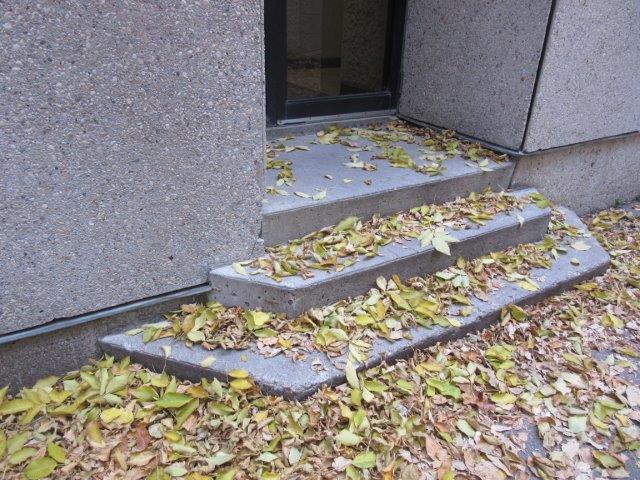
(Humanities Centre theatre exit)

(An uncommon view of Rutherford House)

(Geosciences outdoor rock exhibit by tree grove)

(large spreading tree near Faculty Club)

(hill by Faculty Club)

(a nice, clean DVD print from Universal–A Paramount Picture)
A nice mix of elements including Alan Ladd as Raven (a cat-loving professional killer),Veronica Lake (a pretty nightclub magician-singer), Robert Preston (her cop-boyfriend), and a successful script adaptation of a Graham Greene thriller A Gun for Sale (1936). Recommended: entertaining melodrama. Worth seeing for Ladd’s and Lake’s performances.
